

Squinting through a spotting scope or pausing a firing drill to reel in a target sheet is a familiar headache for any shooter. Standard paper targets tell you how precise your group is, but they demand that you stop, strain your eyes, or wait for a range cold command just to see where that stray round went.
Enter reactive target papers—often called “splatter” or “burst” targets. By trading basic ink for clever material design, they give you instant visual feedback the millisecond a projectile punches through.
How Reactive Target Paper Actually Works
While steel targets react acoustically with an audible ping, reactive paper targets react visually. Their design relies on a precise two-layer construction:
- The Base Layer: A vibrant backing sheet saturated in fluorescent color—typically high-visibility chartreuse, neon yellow, bright white, or hot pink.
- The Top Layer: A brittle, opaque dark coating (usually black or dark red) containing printed bullseyes, gridlines, or silhouette rings.
When a bullet, pellet, or BB penetrates the sheet, the kinetic shock flairs and shears the brittle top layer away from the impact point. Instead of leaving a clean, dark puncture hole that blends into the background, the surface chips outward to form an exaggerated, brightly colored ring around the hole.
Why Swap Standard Paper for Reactive Paper?
| Feature | Standard Paper Targets | Reactive Paper Targets |
|---|---|---|
| Visibility at Distance | Requires spotting scope or binoculars | Readable with naked eyes or low-magnification optics |
| Pacing | Frequent pauses to inspect holes | Continuous shooting and rapid cadence |
| Sighting-in Speed | Slow; micro-adjustments take several trips downrange | Immediate; adjust windage and elevation on the fly |
| Cost per Sheet | Very low | Slightly higher, but extended by cover-up patches |
- Zeroing and Sighting In: When dialing in an optic at 50 or 100 yards, missing by two inches to the left can be invisible on plain black paper. Reactive targets highlight misses instantly, cutting zeroing time and ammo consumption in half.
- Low-Light and Indoor Ranges: Dim backdrops in indoor shooting lanes make dark bullet holes notoriously hard to track. The high-contrast fluorescent burst cuts cleanly through shadows.
- Adhesive Economy: Most reactive paper targets ship with peel-and-stick repair pasters (dots). You can tape over spent holes with fresh reactive dots, giving a single sheet several lives before it needs replacement.
Choosing the Right Reactive Target
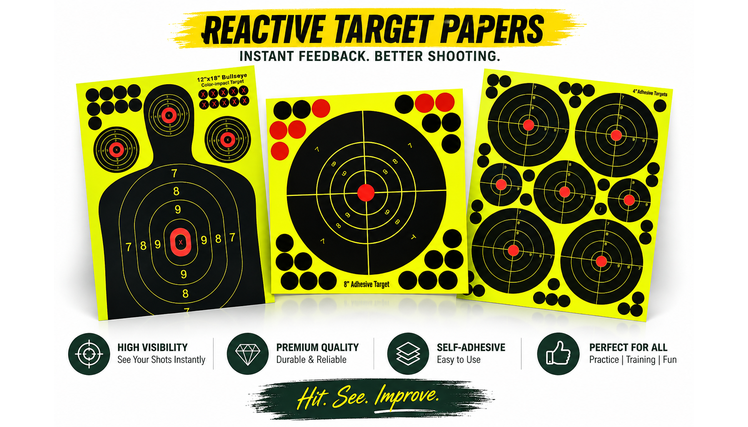
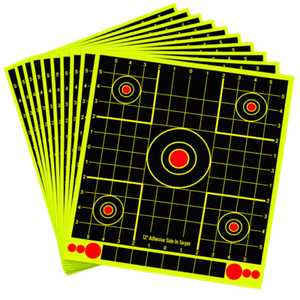
- Grid & Diamond Targets: Best for precision benchrest shooting and zeroing optics, giving you exact 1-inch MOA reference marks for elevation and windage adjustments.
- Anatomical & Silhouette Targets: Great for defensive drills, concealed carry practice, and rapid double-taps where quick zone identification matters more than sub-MOA precision.
- Multi-Color Reaction Sheets: Certain advanced targets feature layered zones where a bullseye hit bursts bright green while off-center perimeter hits burst red or white, giving you peripheral confirmation of shot quality without shifting focus.
Whether you are teaching a beginner who needs the dopamine hit of watching their accuracy improve, or running timed drills where speed and target acquisition are paramount, reactive paper targets bridge the gap between static paper and dynamic steel.